Full Stack Development in 2026: Unlimited Stack Possibilities
"Full stack" no longer means one fixed combo of frontend, backend, and database. In 2026, it means mixing frontend frameworks, runtimes, databases, and even AI inference as independent layers — here's how to actually choose between them.
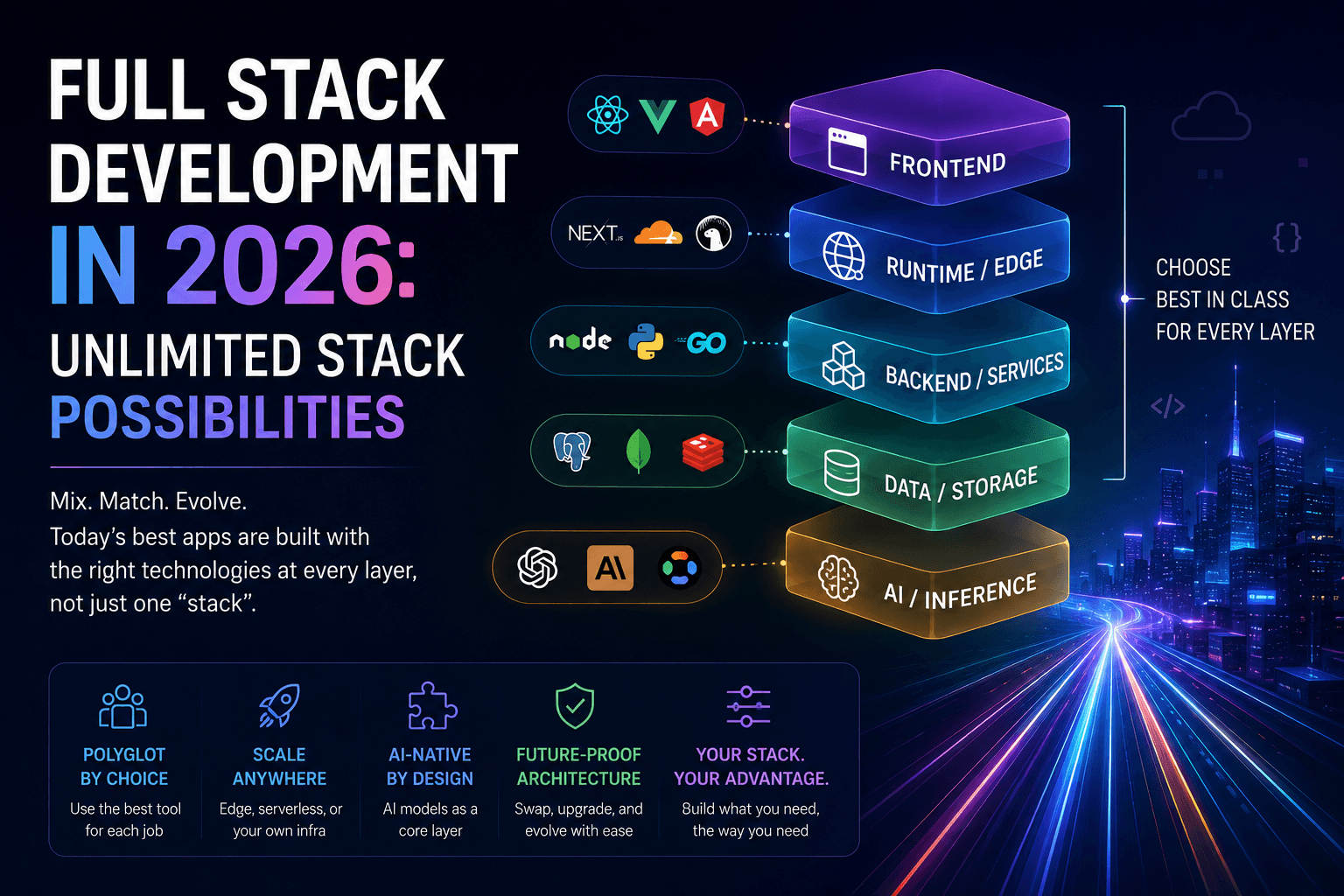
In 2026, "full stack" no longer means one fixed ladder of HTML, server, and database. It means picking from a near-unlimited combinatorial space of runtimes, edge functions, AI layers, and rendering strategies — and knowing which combination fits your product, your team, and your budget.
Why the stack exploded
For over a decade, "full stack" meant roughly the same thing everywhere: a frontend framework, a backend language, a relational database, maybe a cache. Bootcamps taught a near-identical sequence — HTML/CSS, JavaScript, a framework, Node, Postgres, deploy to a single host. That uniformity made hiring and teaching simple, but it also meant most products were built on a stack chosen for familiarity rather than fit.
By 2026, three forces have multiplied the possibilities:
- Edge and serverless compute matured into default deployment targets. Functions now run in dozens of regions automatically, removing the old argument for "just use one big server."
- AI coding assistants made polyglot stacks far cheaper to maintain. Switching a service from Node to Go used to cost a sprint; now it's closer to an afternoon with a capable assistant scaffolding the rewrite.
- Frontend frameworks converged on shared rendering primitives — server components, islands, streaming — so the underlying ideas transfer even when the syntax doesn't [1].
The result is not chaos — it is choice. A team building a content site, a fintech dashboard, and a real-time collaboration tool in 2026 may reasonably choose three entirely different stacks, each optimal for its constraints, without anyone being "wrong."
The new stack grid
Instead of one stack, think in independent layers you mix and match. Each layer can usually be swapped without rewriting the others, as long as the interfaces between them stay typed and stable.
Two layers worth adding to the classic three: an AI/inference layer (model endpoints, embeddings, agent orchestration) and a delivery layer (CDN, edge cache, image and asset pipelines). Both used to be afterthoughts; in 2026 they're planned from day one.
Each box is replaceable independently because deployment platforms standardized the interface between layers — HTTP, WebSockets, and increasingly typed RPC. A Postgres database doesn't care whether it's queried from Node or Rust; a frontend doesn't care whether the API behind it is Express or a Go service, as long as the contract holds.
Frontend: rendering is the real decision
The framework war has quieted; the real decision is rendering strategy — static generation, server components, client islands, or full streaming SSR. Most 2026 teams default to server components with selective client hydration, keeping JavaScript payloads small and shipping interactivity only where it's needed.
| Strategy | Best for | Tradeoff |
|---|---|---|
| Static generation | Marketing pages, blogs, docs | Rebuild needed for content changes |
| Server components | Dashboards, content-heavy apps | Server load scales with traffic |
| Client islands | Mostly-static pages with pockets of interactivity | More build tooling complexity |
| Streaming SSR | Personalized, data-heavy views | Harder caching strategy |

Backend: runtime diversity is normal now
Node remains common, but Bun and Deno are mainstream for new services, and Go or Rust handle performance-critical paths like media processing, real-time matching, or high-throughput ingestion. Polyglot backends used to be a maintenance burden; typed API contracts and AI-assisted refactoring have made switching languages between services far less risky than it once was.
A practical pattern in 2026: keep the orchestration layer (auth, routing, business rules) in whatever language the team knows best, and isolate performance-critical or compute-heavy work in a small number of services written in a faster language, communicating over a typed RPC boundary.
// Example: typed RPC contract shared across services
export const getUser = defineRoute({
input: z.object({ id: z.string() }),
output: UserSchema,
handler: async ({ id }) => db.user.findUnique({ where: { id } }),
});
Common backend pairings in 2026
The data layer: more than one database
Relational databases like Postgres remain the default for transactional data, but it's now routine for a single product to run three or four data stores side by side: Postgres for core records, Redis for sessions and rate limits, a vector database for semantic search or retrieval-augmented generation, and an edge-replicated SQLite variant for low-latency reads close to the user.
The skill isn't memorizing every database — it's knowing which access pattern belongs where. Transactional writes belong in a relational store. High-frequency, low-stakes reads belong in cache or edge replicas. Similarity search over embeddings belongs in a vector store. Mixing these up is one of the most common architecture mistakes new full-stack teams make.
AI as a stack layer, not a feature
The biggest 2026 shift: AI inference is now treated as its own layer, sitting alongside the database and cache, with its own deployment, latency, and cost considerations. Teams provision model endpoints the way they once provisioned databases — choosing between hosted APIs and self-hosted open models based on data sensitivity, latency requirements, and cost per request.
This shows up concretely in a few ways:
- Embedding pipelines run alongside normal write paths, so new content is searchable the moment it's saved.
- Agent orchestration sits behind an API the frontend calls like any other endpoint, but internally may make several model calls, tool calls, and retries.
- Cost monitoring for inference is now a dashboard metric next to database load and CDN bandwidth, not an afterthought discovered at the end of the month.
"The skill that matters most in 2026 isn't memorizing one stack — it's understanding tradeoffs well enough to assemble the right one for a given product."
Comparing three real 2026 stacks
| Use case | Frontend | Backend | Data |
|---|---|---|---|
| Content site | Astro / Next.js | Edge functions | Headless CMS + CDN |
| SaaS dashboard | React + server components | Node / Bun | Postgres + Redis |
| Real-time collab tool | Solid / Svelte | Elixir / Go | Postgres + WebSocket layer |
Notice none of these stacks share a backend language, and only two share a frontend approach. That's the point — each was chosen for its rendering and concurrency needs, not for consistency with the others.
How to pick, practically
- Start from constraints — team skills, latency needs, budget — not hype. A two-person team should rarely choose a five-language stack regardless of how elegant it looks in a conference talk.
- Choose rendering strategy before framework; the framework follows from it. Decide whether you need streaming, static output, or heavy interactivity first.
- Treat AI inference as a planned layer with its own cost model, not a bolt-on added after launch.
- Favor typed contracts between services so you can swap languages later without breaking consumers.
- Default to the simplest combination that meets today's requirements, and leave clear seams for swapping a layer later rather than over-engineering for scale you don't have yet.
A short decision checklist
Before committing to a stack, it helps to answer a handful of direct questions rather than starting from a list of trendy tools:
- Does this product need real-time updates, or is request/response enough?
- Will most traffic be reads, writes, or a mix — and what does that imply for caching?
- Is there genuinely a need for sub-100ms global latency, or is one well-placed region enough?
- Does the team already know a language well enough to move fast in it, or are we choosing for résumé appeal?
Is it still worth learning a "classic" stack in 2026?
Yes. Fundamentals — HTTP, relational modeling, caching, and one statically typed language — transfer across every stack combination above. They're the constants underneath all this new flexibility, and they're what let you evaluate a new framework quickly instead of starting from zero each time.
How many layers should a beginner actually learn first?
Three: one frontend framework, one backend language with a web framework, and Postgres. That combination alone covers a large share of real-world products. Edge functions, vector databases, and AI orchestration are worth learning once the fundamentals are solid, not before.
Conclusion
Full stack development in 2026 rewards versatility over memorization. The winning approach isn't picking the "best" stack — it's understanding the layers well enough to combine them deliberately for each project, and resisting the urge to add a layer just because it's available. If you're building your skills for this landscape, structured mentorship helps more than chasing every new framework that trends for a week.
Want a tailored learning path or freelance roadmap into 2026's stack landscape? Explore our student programs or check freelance opportunities. You can also browse more breakdowns like this on the BCS blog.