Ranking coding models based on Intelligence/Cost
An analytical look at real-world OpenRouter data to determine which foundation models dominate active agent pipelines, weighing cognitive reasoning capabilities against execution costs and 7-day token volumes.
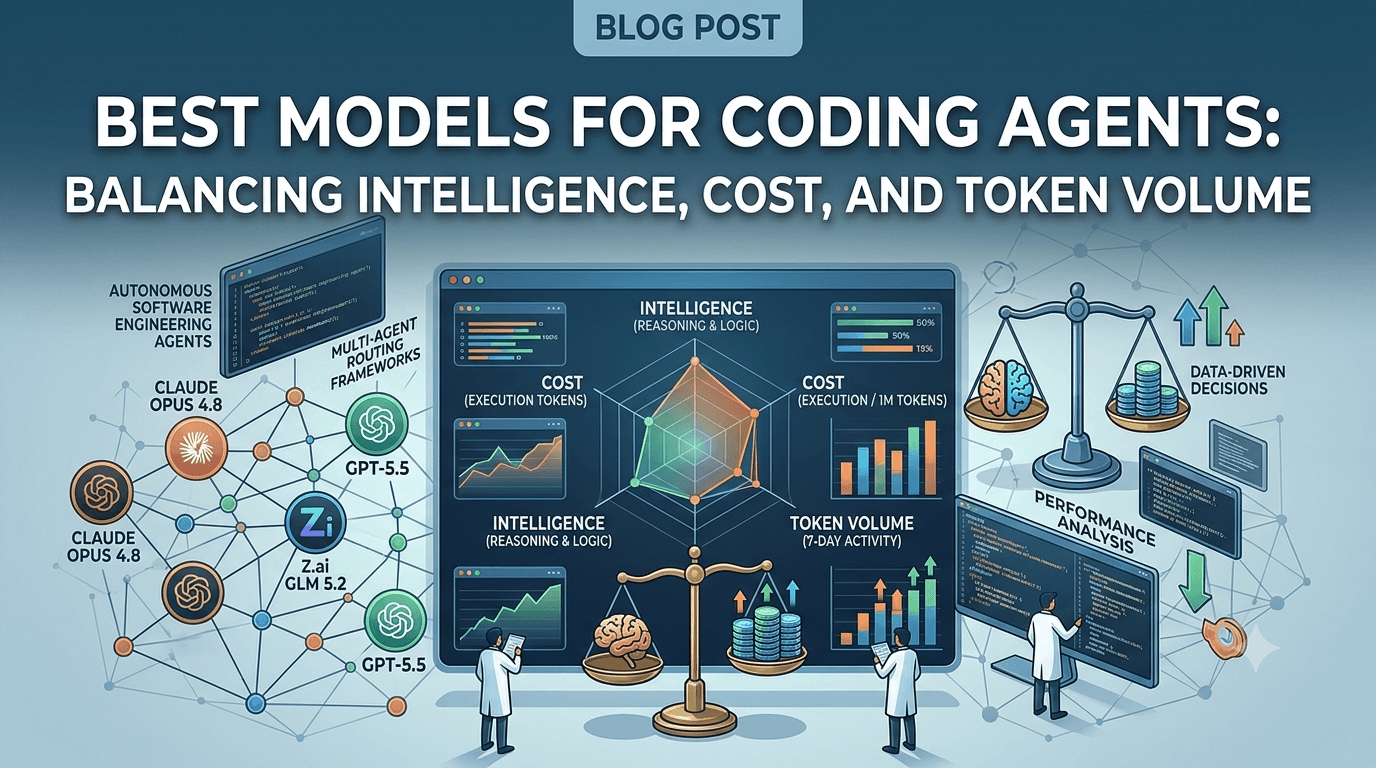
The landscape of autonomous software engineering has undergone a monumental shift. Developers are transitioning away from chat-based interfaces to fully asynchronous, multi-agent pipelines capable of self-debugging, project-level planning, and repository-wide modifications. To build reliable systems, selection of the underlying foundation model is the single most critical decision. By analyzing recent OpenRouter data, this guide looks at the best models for coding agents based on intelligence, cost efficiency, and real-world token volume.
The State of OpenRouter Coding Models
When choosing a model for coding agents, three factors dictate success: cognitive capacity (reasoning), cost constraints, and token usage trends. Analyzing actual token volume in the wild reveals which models development teams trust to power active, production-grade workflows.
| Model Name | Developer | Input Cost (per 1M) | Output Cost (per 1M) | Context Window | 7-Day Volume |
|---|---|---|---|---|---|
| Claude Opus 4.8 | Anthropic | $5.00 | $25.00 | 1.00M | 2.11 Trillion |
| Claude Opus 4.7 | Anthropic | $5.00 | $25.00 | 1.00M | 2.53 Trillion |
| Z.ai GLM 5.2 | Z.ai | $0.95 | $3.00 | 1.00M | 1.96 Trillion |
| Claude Sonnet 4.6 | Anthropic | Mid-Tier | Mid-Tier | 1.00M | 1.55 Trillion |
| OpenAI GPT-5.5 | OpenAI | $5.00 | $30.00 | 1.05M | 1.03 Trillion |
| OpenAI GPT-5.4 | OpenAI | $2.50 | $15.00 | 1.05M | 427 Billion |
| Google Gemini 3.5 Flash | $1.50 | $9.00 | 1.05M | 422 Billion |
Deep Dive: The Top Contenders
1. Anthropic Claude Opus 4.8 & 4.7 (The Agentic Benchmarks)
Anthropic's Opus family remains a dominant force for agentic software engineering, commanding a massive portion of OpenRouter's total token traffic.
- Claude Opus 4.7: Released in mid-April 2026, Opus 4.7 has earned a staggering 2.53T tokens of usage, maintaining a permanent spot in production engineering pipelines. Engineered specifically for long-running, asynchronous agents, it excels at maintaining coherence through complex, multi-step tasks across large codebases.
- Claude Opus 4.8: The newer sibling, released on May 27, 2026, has quickly claimed 2.11T tokens. Optimized for highly autonomous agent loops and memory-driven tasks, it is particularly suited for end-to-end project orchestration, offering stronger reasoning support over prolonged sessions where developer interactions are minimal.
"For multi-stage debugging and large-scale refactoring where context drift can break the build, the Opus family's stability and reasoning reliability make the premium cost worthwhile."
2. Z.ai GLM 5.2 (The Disruption Leader)
The most dramatic market entry of late is GLM 5.2 by Z.ai, launched on June 16, 2026. Within a short span of its release, it has already amassed 1.96T tokens. This rapid adoption is driven by its highly competitive pricing structure.
At just $0.95 per million input tokens and $3.00 per million output tokens, GLM 5.2 provides deep reasoning capabilities at a fraction of the cost of its frontier peers. By offering high and xhigh reasoning parameters, developers can toggle thinking depths dynamically. For long-horizon agent loops that require continuous codebase scanning and verification, GLM 5.2 presents a very attractive balance of cost and capability.
3. OpenAI GPT-5.5 & GPT-5.4 (The Frontier Competitors)
OpenAI's offerings are built around unified pipelines designed for complex professional workloads, combining their coding-specific Codex line with general reasoning.
- GPT-5.5: Sits at 1.03T tokens with a premium pricing of $5.00/M input and $30.00/M output. Its 1M+ token context window features a 922K input and 128K output split, making it powerful for heavy synthesis and multimodal coding tasks where image inputs (like UI screenshots) are integrated into development cycles.
- GPT-5.4: Represents a balanced entry-point ($2.50/M input, $15.00/M output) with 427B tokens. It serves as a reliable default for standard software engineering loops, tool use, and instruction-following.
4. Google Gemini 3.5 Flash (The High-Efficiency Specialist)
Gemini 3.5 Flash provides near-Pro coding capability with highly optimized execution speeds. Priced at $1.50/M input and $9.00/M output, it represents a strong candidate for high-frequency execution loops. It is highly optimized for parallel agent execution and supports fine-grained thinking adjustments (minimal, low, medium, and high), enabling developers to tune latency and cost for smaller tasks.
Architecting a Multi-Agent System: Cost vs. Performance
In real-world systems, utilizing a single model for every sub-task is rarely practical. A robust system utilizes a **tiered routing framework** where tasks are directed based on complexity, context size, and the cognitive effort required.
Tier 1: High-Frequency Loops
Tasks like reading files, syntax linting, and initial plan formulation are routed to lightweight models like Gemini 3.5 Flash or GPT-5.4 to maintain speed and low costs.
Tier 2: Code Generation & Reasoning
Complex logic generation and multi-file code execution are sent to GLM 5.2 (under 'high' reasoning) to leverage its reasoning capacities at budget-friendly rates.
Tier 3: Critical Orchestration
Final system integration, architectural decisions, and difficult debugging failures are escalated to Claude Opus 4.8 or GPT-5.5 for maximum accuracy.
Context Operations
For large context windows, leveraging the pricing of GLM 5.2 ($0.95/M) or Gemini 3.5 Flash ($1.50/M) helps prevent costs from scaling unsustainably.
Below is an example of an agent routing manager that illustrates how a team might build a dynamic task selector in Python:
class CodingAgentRouter:
def __init__(self):
# Current active metrics from our OpenRouter analysis
self.registry = {
"claude_opus_4_8": {"input_cost": 5.00, "output_cost": 25.00, "reasoning": "ultra-high"},
"glm_5_2": {"input_cost": 0.95, "output_cost": 3.00, "reasoning": "high"},
"gemini_3_5_flash": {"input_cost": 1.50, "output_cost": 9.00, "reasoning": "configurable"}
}

def determine_optimal_route(self, task_type: str, estimated_context_tokens: int) -> str:
"""
Routes incoming software tasks to optimize accuracy and cost.
"""
if task_type == "architectural_refactor" or estimated_context_tokens > 600000:
# Demands extreme coherence and long-horizon planning
return "claude_opus_4_8"
elif task_type == "logic_implementation":
# Demands high reasoning capability, but benefits from GLM's lower pricing
return "glm_5_2"
else:
# Quick syntax checking, boilerplate generation, or test sweeps
return "gemini_3_5_flash"

# Example routing logic for automated codebase updates
router = CodingAgentRouter()
selected_model = router.determine_optimal_route("logic_implementation", 150000)
print(f"Routing task to: {selected_model}")
# Output: Routing task to: glm_5_2
At Bharat AI Career Labs, we emphasize these modular engineering concepts. We train our students and freelancers to construct scalable, tiered agent pipelines that balance reliability and economic performance.
Click to view: Why context efficiency matters in 2026
In 2026, context windows have standardized around 1M+ tokens. However, sending an entire codebase in every prompt quickly becomes cost-prohibitive. Employing intermediate caching systems, vector indexes, or cost-effective reasoning engines like GLM 5.2 is essential to keep operational costs manageable.
Conclusion
The OpenRouter data demonstrates that while Anthropic's Claude Opus family holds a strong position for critical, long-horizon tasks, cost-efficient alternatives like Z.ai's GLM 5.2 are changing how teams scale agent actions. By employing tiered routing architectures, engineering teams can optimize their budgets without sacrificing the capabilities of top-tier models.
Are you looking to implement production-grade AI agent pipelines in your software development lifecycle? Reach out to our consultants to design custom multi-agent systems tailored to your technical stack.