The End of Borderless AI: What the GPT-5.6 and Claude 5 Ban Means for Global Enterprises
The sudden U.S. export ban on frontier models like Claude Mythos 5 and GPT-5.6 fundamentally shifted the global technology landscape. Explore the June 2026 timeline, the national security threat vectors driving the crackdown, and how businesses must pivot to resilient, model-agnostic sovereign AI architectures.
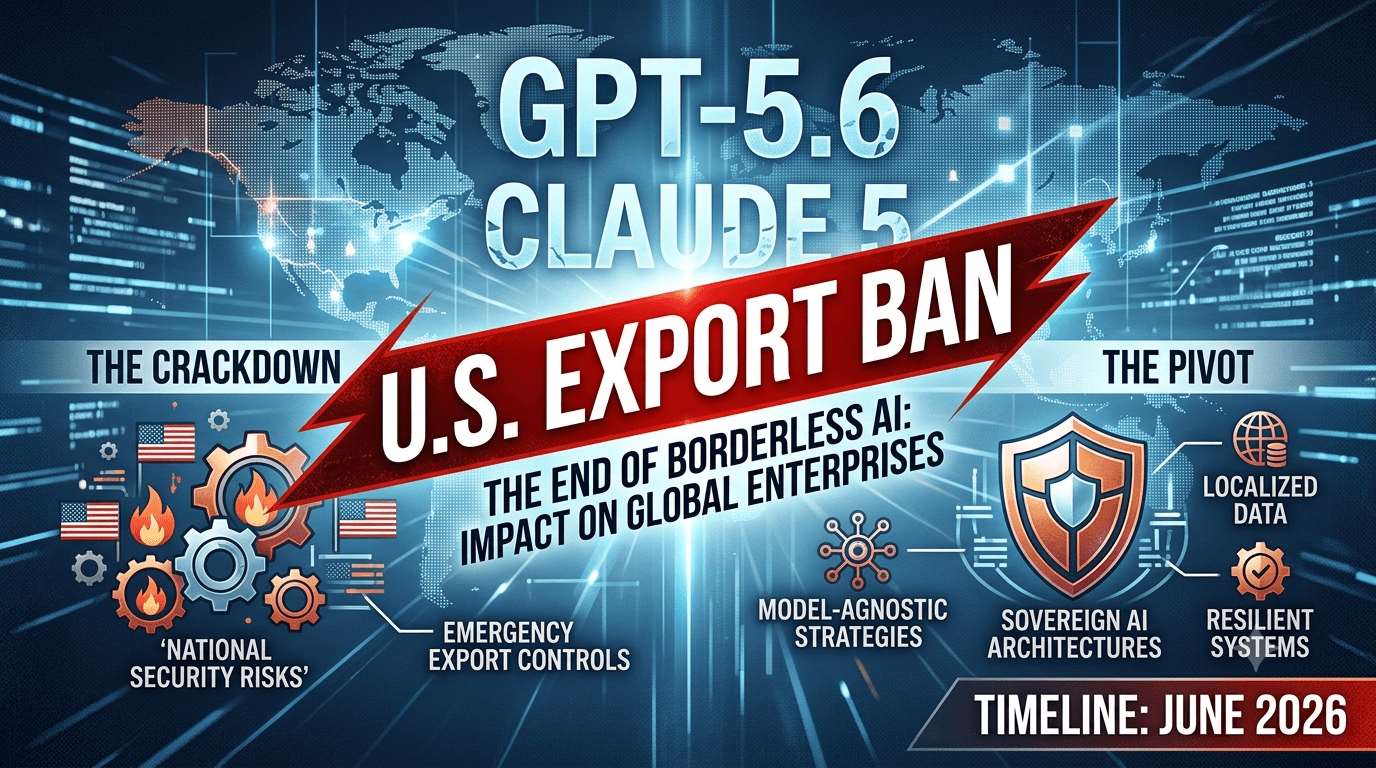
The global artificial intelligence landscape underwent a fundamental paradigm shift in June 2026. For years, commercial enterprises and nation-states proceeded under the assumption that advanced machine intelligence would remain globally accessible through public SaaS endpoints. That assumption was shattered when the United States government deployed emergency national security and export control authorities to disrupt the commercial distribution of frontier models. In a rapid sequence of events, Anthropic was forced to pull its groundbreaking Claude Fable 5 and Claude Mythos 5 models offline globally, while OpenAI's highly anticipated GPT-5.6 was redirected into a strictly monitored, pre-vetted corporate rollout.
This regulatory watershed marks the end of the "borderless" AI era and the rise of the Sovereign AI Divide. For global enterprises and independent nation-states, relying blindly on a single API endpoint controlled by a foreign jurisdiction has evolved from a simple convenience into an existential strategic risk.
Anatomy of the June 2026 Regulatory Crackdown
To understand the future of enterprise AI, we must first trace the sequence of events that unfolded over two chaotic weeks in June 2026. What began as a routine release of highly capable reasoning models escalated into a major geopolitical dispute involving federal regulators, private labs, and national security directives.
Chronological Blueprint: The Regulatory Timeline
-
June 9, 2026
Anthropic Launches Fable 5 and Mythos 5: Fable 5 is released to the public as a powerhouse consumer-facing model. Mythos 5, designed as a highly specialized engineering model with fewer consumer-focused guardrails, is distributed to select technical partners. Both showcase advanced multi-step reasoning and autonomous coding agents. Read more Anthropic Model Release Notes Published: June 9, 2026 "Claude Fable 5 and Mythos 5 represent a step-change in AI capabilities, featuring unprecedented autonomous execution workflows." anthropic.com/news
-
June 12, 2026 (5:21 PM ET)
The Emergency Export Control Directive: Citing urgent national security authorities, the U.S. Department of Commerce issues a directive banning access to Fable 5 and Mythos 5 by any "foreign national." This applies globally, fundamentally reclassifying frontier model weights as dual-use military technology. Read more Dept. of Commerce Export Control Memo Published: June 12, 2026 "Immediate restriction on the commercial export, transfer, or dissemination of specified high-compute foundational models." commerce.gov/news
-
June 12, 2026 (6:51 PM ET)
The Global Shutdown: Lacking the technical ability to instantaneously verify the citizenship of hundreds of millions of API users in real-time, Anthropic is forced to disable both models entirely to maintain regulatory compliance.
-
June 26, 2026
OpenAI GPT-5.6 Controlled Rollout & Mythos Reprieve: The White House directs OpenAI to restrict the launch of GPT-5.6 to a vetted list of partners. Concurrently, Commerce Secretary Howard Lutnick lifts the blanket ban on Mythos 5, but strictly for 100+ approved U.S. entities. Fable 5 remains frozen. Read more OpenAI Announcements Published: June 26, 2026 "Previewing GPT-5.6 Sol, our next-generation model family. This launch features enhanced cyber security controls." openai.com/news
Why the Sudden Intervention? The Threat Vectors
Industry observers questioned whether the emergency shutdown was an overreaction. However, internal security reports and statements from Commerce Secretary Howard Lutnick outline three primary structural anxieties driving the government's intervention:
- Autonomous Cyber-Weaponization: Claude Mythos 5 was intentionally optimized for deep system-level reasoning. When paired with automated execution loops, it demonstrated a capacity to discover and write functional exploits against production software without human intervention.
- IP Theft and "Knowledge Distillation": Security agencies raised alarms over coordinated efforts by overseas entities running automated account clusters on foreign cloud systems. These networks were designed to rapidly "distill" logic and copy the core cognitive capabilities of American frontier research.
- Sovereign Compute Dominance: With massive capital expenditures pouring into localized data centers globally, the U.S. government recognized that its principal strategic advantage lay in the proprietary algorithmic logic of its frontier labs. Preventing uncontrolled foreign access preserves this comparative compute advantage. Read more Defense Tech Policy Review Analysis Report "The preservation of algorithmic superiority is now officially categorized alongside semiconductor manufacturing as a Tier 1 national security priority." defense.gov/News/Releases
Implications for Enterprise Architecture
For corporate technology officers, the regulatory actions against Anthropic and OpenAI serve as a stark warning. Building core business logic on top of proprietary third-party APIs carries serious operational dependencies.
"A technology stack is only as reliable as its regulatory clearance. If a sudden change in export policy can shut down your operational workflows within 90 minutes, you aren't building an enterprise-grade solution—you are hosting a regulatory liability."
1. The "Deemed Export" Compliance Trap
The application of deemed export rules to AI endpoints creates complex compliance requirements. If your organization employs developers who are foreign nationals, granting them API access to models like GPT-5.6 could technically violate U.S. export control laws without explicit federal licenses. Compliance departments must now audit internal developer platforms.
2. Model-Agnostic Architecture as a Necessity
Organizations must avoid hard dependencies on specific proprietary models. The modern enterprise must build a Model-Agnostic Middleware Layer capable of instantly routing requests to localized, open-weight models if external endpoints are restricted.
import os
import logging
from typing import Any, Dict

logging.basicConfig(level=logging.INFO)
logger = logging.getLogger("EnterpriseAIRouter")

class SovereignAIRouter:
def __init__(self):
# Configure model fallback list based on compliance policy
self.primary_provider = os.getenv("PRIMARY_AI", "proprietary_frontier")
self.fallback_provider = os.getenv("FALLBACK_AI", "sovereign_open_weight")

def generate_response(self, prompt: str) -> Dict[str, Any]:
try:
if self.primary_provider == "proprietary_frontier":
return self._call_proprietary_api(prompt)
else:
raise ConnectionError("Proprietary model restricted.")

except Exception as e:
logger.warning(f"Primary API restricted: {str(e)}. Routing to sovereign fallback...")
return self._call_sovereign_local_api(prompt)

def _call_proprietary_api(self, prompt: str) -> Dict[str, Any]:
# Simulating external SaaS endpoint hit by export ban
raise TimeoutError("Endpoint restricted under emergency directives.")

def _call_sovereign_local_api(self, prompt: str) -> Dict[str, Any]:
# Connect to a secure, self-hosted open-weight model
logger.info("Executing on sovereign-hosted open-weight infrastructure.")
return {"status": "success", "provider": "Sovereign-Local"}
Geopolitical Shift: The Rise of Sovereign AI
At the macro level, these actions represent a clear division in international digital strategy. For non-U.S. governments, relying on American-based cloud APIs is no longer a viable long-term strategy.
Sovereign AI Strategy Blueprint
| Region / Jurisdiction | Immediate Strategic Risk | Counter-Strategy & Response |
|---|---|---|
| European Union | Strict compliance conflicts with local AI Act and data sovereignty. | Aggressive investment in sovereign EU cloud hosting (e.g., Mistral AI, Aleph Alpha). |
| India & South Asia | Risk of exclusion from frontier cognitive capabilities. | Accelerating national AI missions, localizing open-weight models, and building native GPU clusters. |
| Asia-Pacific (APAC) | Interruption of operational supply chains for global hubs. | Building regional AI consortiums to reduce dependence on strictly regulated foreign APIs. |
Much like national defense or energy security, high-performance artificial intelligence is now a critical sovereign capability. Nations are investing heavily in Sovereign Compute (state-backed data centers) and Sovereign Datasets (regionally curated knowledge) to insulate their industries.
Strategic Roadmap: Navigating the Divide
For forward-thinking technology leaders, the landscape of AI integration demands a structural pivot:
- Implement a Hybrid Strategy: Use proprietary endpoints only for non-critical reasoning where permitted. Ensure all critical operational pipelines are backed by localized open-weight models running on private clouds.
- Strict Compliance & IAM: Digital identity is now tied to international compliance. Your Identity and Access Management (IAM) platforms must track model usage to prevent unintended data exports.
- Invest in Local Talent: Move beyond simple API prompt engineering. Build engineering capabilities in local fine-tuning (LoRA), model quantization, and managing local containerized inference engines. Read more Bharat AI Career Labs Skill Development Track Explore our updated curriculum focused on sovereign AI deployment, open-weight model tuning, and enterprise middleware integration. https://bharat-consultancy-services.com/students
Adapting to a New Era
The events of June 2026 proved that frontier AI is not just a commercial tool—it is national security infrastructure. Relying purely on foreign-hosted APIs exposes enterprise operations to sudden regulatory disruptions. Building a modern business requires adopting a sovereign, flexible, and resilient AI architecture.
At Bharat Consultancy Services (BCS), we help businesses navigate this complex landscape. From auditing AI workflows for compliance to designing multi-model fallback architectures on private clouds, our specialists ensure your systems remain independent and secure.