OpenClaw vs. Hermes Agent
Both OpenClaw and Hermes Agent run open-source AI assistant workloads straight from your messaging apps, but they split on philosophy. Here is how to choose between OpenClaw’s file-based memory and Hermes's self-improving skill loop.
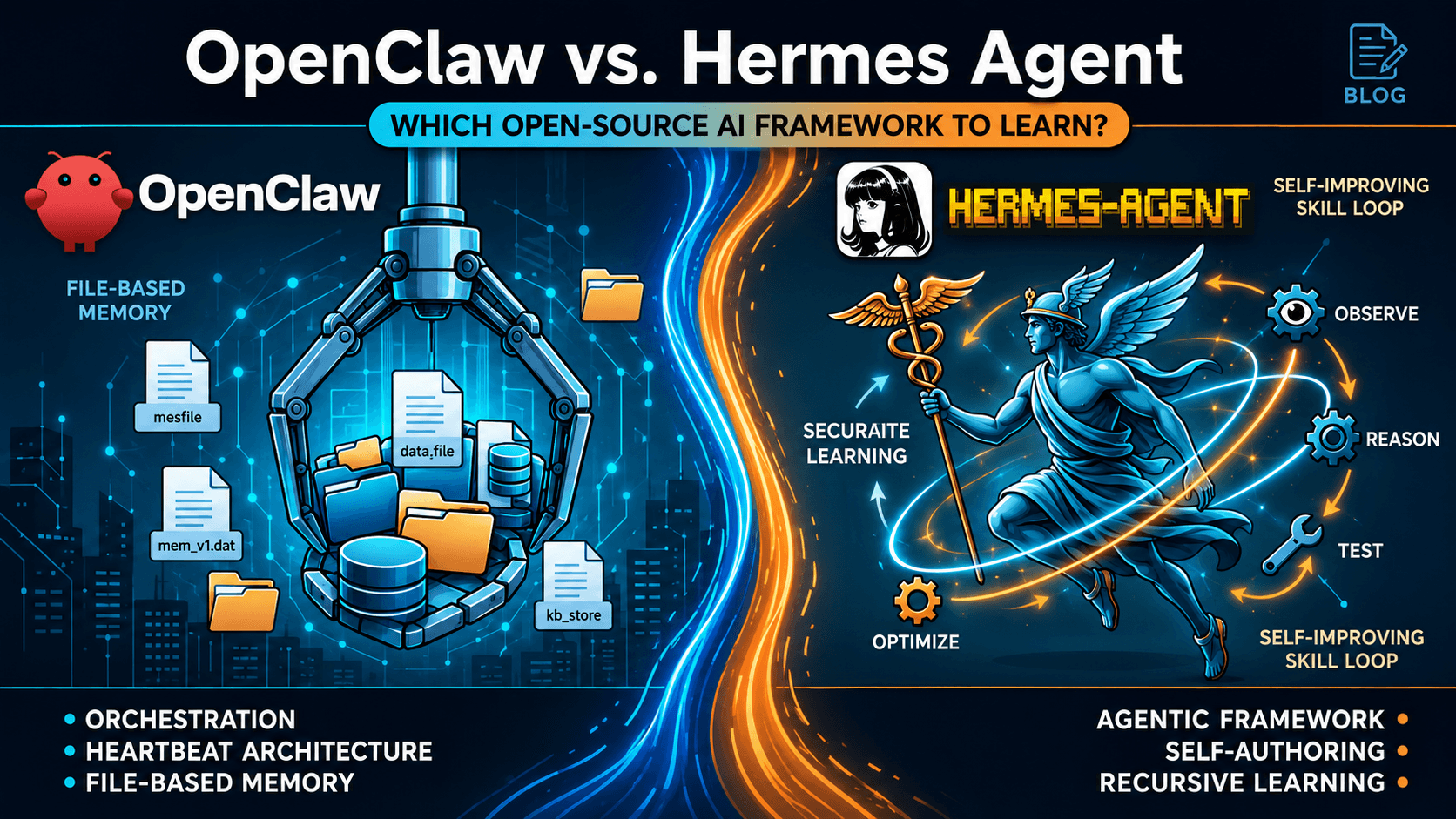
Two names keep showing up in every "best open-source AI agent" thread right now: OpenClaw and Hermes Agent. Both are free, self-hosted, and run on infrastructure you control. Both turn the messaging apps you already use into a command line for an AI. And both can read files, browse the web, and act for you from nothing more than a text message. Where they part ways is philosophy — and that difference is exactly what decides which one is worth learning first.
Quick Snapshot: Two Different Bets on Agentic AI
Before going deep, here's the short version. Skim this, then jump to whichever section answers your real question.
| OpenClaw | Hermes Agent | |
|---|---|---|
| Built by | Peter Steinberger and the open-source community | Nous Research |
| First released | November 2025, under the name Warelay | February 2026 |
| License | MIT, fully open source | MIT, fully open source |
| Core idea | A flat, human-readable memory you can read in any text editor, woken on a heartbeat schedule | A closed learning loop that writes and refines its own skills as it works |
| Memory format | Markdown and YAML files on disk | FTS5 full-text search plus LLM summarization and user modeling |
| Standout strength | Largest community skill library and the widest channel support, including iMessage and voice | Self-authored skills and serverless hosting that hibernates between sessions |
| Headline risk | Broad permissions plus a documented history of prompt-injection and skill-vetting issues | Too new for an independent security track record either way |
What Is OpenClaw, Exactly?
OpenClaw is a personal AI assistant you run on your own machine. It started life in November 2025 as a side project called Warelay, itself descended from an earlier assistant the developer had nicknamed after Anthropic's Claude. Trademark complaints forced a rename in late January 2026, and a second rename three days later settled on the lobster-themed name it carries now. What didn't change through any of that was the core design: memory and skills are stored as plain Markdown and YAML files you can open, edit, and back up like any other text file, and a background heartbeat process wakes the agent on a configurable interval so it can act without you prompting it first.
That combination — fully open source, local-first storage, and autonomous scheduling — is a big part of why the project became one of the fastest-growing open-source repositories in GitHub history within its first weeks. A companion social network for AI agents, built by a separate developer, amplified the moment further as people experimented with letting their agents post, negotiate, and even build dating profiles on their behalf — sometimes without realizing exactly what their agent had done unsupervised. Steinberger announced in February 2026 that he was joining OpenAI, with day-to-day stewardship of OpenClaw handed to an independent foundation so the project could keep developing without depending on one person.
What Is Hermes Agent?
Hermes Agent comes from Nous Research, the lab behind the Hermes, Nomos, and Psyche open-weight model families, and launched in February 2026 — explicitly positioned as the next step after OpenClaw rather than a from-scratch competitor. That positioning shows up in the product itself: the setup wizard automatically scans for an existing OpenClaw configuration folder and offers a guided migration before you even pick a model.
The defining feature is a closed learning loop. When Hermes solves a hard problem, it writes a reusable skill document describing how, rather than relying solely on a human or community contributor to author one. Those skills improve as they're reused, the agent periodically nudges itself to persist anything worth remembering, and cross-session recall runs on full-text search paired with an LLM summarizer and a user-modeling layer called Honcho. According to coverage from NVIDIA's developer blog, Hermes crossed a large GitHub star count within its first three months and briefly topped OpenRouter's most-used-agent ranking — figures worth treating as a snapshot rather than a permanent record, since this category is moving fast.
Architecture and Core Philosophy
Both agents separate "what the agent is" from "what model is thinking," which is what lets either one run on Claude, GPT, Gemini, or a fully local model without a rewrite. The difference is in how each layer is structured.
OpenClaw: Three Layers and a Heartbeat
OpenClaw separates a Brain layer (the model-agnostic persona and instructions), a Hands layer (tools, browser automation, and file access that turn conversation into action), and a Gateway that handles routing, authentication, and session state as a background daemon, binding locally by default. A heartbeat scheduler — every 30 minutes out of the box, hourly when using Anthropic OAuth — reads a checklist file in your workspace and decides whether anything needs action, messaging you only when there's something worth saying.
Hermes Agent: A Self-Improving Skill Loop
Hermes runs the same conceptual split between model and orchestration, but the orchestration layer is built around skill creation rather than a fixed checklist. A newer goal-and-judge mechanic lets you hand the agent a target and success criteria: a worker process proposes a solution, a separate judge model grades it, and the loop repeats until the judge signs off — closer to an internal QA pass than a one-shot response.
Memory and Skills: How Each Agent Gets Smarter
OpenClaw's memory is deliberately boring in the best sense: everything lives as Markdown and YAML under your workspace, so you can grep it, diff it, or delete a single fact without touching anything else. Its skill format — a portable SKILL.md document — has produced a large community directory you can browse and install from, the same way you'd add a package.
Hermes takes the opposite default. Instead of waiting for a human to document a workflow, it authors and revises its own skill files as it solves problems, then indexes everything with full-text search and LLM summarization for fast recall across sessions. The practical upside for anyone choosing between the two: both ecosystems publish to the same open agentskills.io standard, so a well-written skill from one project will often run on the other with little or no modification.
Platform Reach and Model Support
Both projects connect to most of the same chat apps, which is unsurprising — that overlap is the whole point of a "messaging-first" agent. The differences show up at the edges.
| Category | OpenClaw | Hermes Agent |
|---|---|---|
| Shared channels | WhatsApp, Telegram, Slack, Discord, Signal | WhatsApp, Telegram, Slack, Discord, Signal |
| Extra channels | iMessage with voice and a live Canvas on macOS/iOS, plus LINE, Zalo, Nostr, Synology Chat, and Twitch | DingTalk, Feishu, WeCom, Weixin, QQ Bot, Matrix, Mattermost, and Home Assistant |
| Cloud models | Anthropic, OpenAI, Google | Anthropic, OpenAI, Google, plus native AWS Bedrock, Azure AI Foundry, xAI Grok OAuth, and more, switchable with one command |
| Local models | Any OpenAI-compatible server, including Ollama and LM Studio | Same, with Ollama and LM Studio treated as first-class options |
Hermes also has one trick OpenClaw doesn't document: a local proxy command that exposes an existing Claude Pro, ChatGPT Pro, or SuperGrok subscription as an OpenAI-compatible endpoint, so unrelated coding tools can use the same login instead of a separate API key.
Security: The Permission Problem Both Share
Any agent that can read your messages, run shell commands, and browse the web on your behalf carries a bigger blast radius than a chatbot that only talks back. OpenClaw has the longer public track record here, and it isn't a clean one: a critical remote-code-execution vulnerability affected versions before v2026.1.29 and has since been patched, and security researchers at Cisco tested a third-party community skill and found it quietly exfiltrating data through a prompt-injection attack, pointing to thin vetting in the open skill marketplace. One of OpenClaw's own maintainers put it bluntly on the project's Discord: if you can't comfortably run a command line, this is too dangerous a project to use unsupervised.
Hermes Agent doesn't have an equivalent public incident history yet, simply because it's only been out a few months. That isn't the same as being safer — it inherits the identical category of risk from any agent with broad tool and messaging access, and it pulls skills from the same open standard OpenClaw uses.
Hardening checklist for either agent: pin to a current, patched release; gate irreversible actions like payments, deletions, and outgoing emails behind explicit human approval; set hard spending limits at the model provider level, not just inside the agent's own config; and never expose the gateway to the public internet unless you fully understand the network setup.
Deployment: From a $5 VPS to a DGX Spark
OpenClaw runs as a background daemon — systemd on Linux, a LaunchAgent on macOS — and is built to live on a single always-on machine, with NVIDIA's NemoClaw reference stack offering a sandboxed, fully local deployment path on hardware like the DGX Spark. Hermes Agent supports six hosting backends, including Docker, SSH, and Singularity, plus two serverless options — Daytona and Modal — that hibernate when idle, keeping cost close to zero between sessions while still being reachable from chat at any time. Hermes also ships native desktop apps for macOS, Windows, and Linux, and both projects are tuned to run well on local open-weight models on consumer NVIDIA GPUs.
Switching Sides: Migrating from OpenClaw to Hermes
If you already run OpenClaw and want to try Hermes without rebuilding everything, the migration path is a first-class feature rather than an afterthought. Hermes's setup wizard detects an existing OpenClaw configuration folder automatically and offers to import it before you finish setup.
hermes claw migrate                    # interactive migration (full preset)
hermes claw migrate --dry-run          # preview what would be migrated
hermes claw migrate --preset user-data # migrate without secrets
hermes claw migrate --overwrite        # overwrite existing conflicts
Running the dry-run flag first is the sensible default — you're handing a new agent your old one's memory and, potentially, its credentials, and a preview costs nothing.
Which One Should You Actually Learn?
Reach for OpenClaw if you want the largest community skill library, voice and Canvas support on Apple devices, and the most battle-tested project to study how real-world agent security failures actually happen. Reach for Hermes Agent if you want to study a self-improving skill loop in production, need serverless hosting that costs almost nothing while idle, or you already run OpenClaw and want to evaluate the newer architecture without losing your existing setup.
For students assembling an AI engineering portfolio, OpenClaw's architecture is currently the more widely documented and copied pattern, so it's a reasonable place to start before comparing it against Hermes's learning loop — our hands-on agent-building tracks at /students walk through exactly this kind of comparison project. For freelancers, OpenClaw's larger install base means a bigger pool of clients who already need help hardening an existing setup, while Hermes's migration tooling is quietly creating fresh demand from people moving off OpenClaw — both are worth listing as services; see /freelance for how other BCS freelancers are packaging this work.
Frequently Asked Questions
Is OpenClaw or Hermes Agent actually free?
Yes — both are MIT-licensed and fully open source, and you self-host them. The only ongoing cost is whatever model API usage or local compute you choose to run.
Can I run either one without sending data to the cloud?
Yes. Both support fully local models through tools like Ollama or LM Studio, which keeps inference and memory on your own hardware end to end.
Do I have to pick just one?
No. Hermes's migration tooling exists specifically because many people want to trial it without giving up an existing OpenClaw setup — run them on separate workspaces or ports and compare directly on your own workload.
Conclusion: Bet on the Skill, Not the Brand
OpenClaw and Hermes Agent will both keep changing fast — star counts, rankings, and feature lists in this space shift by the month, and whatever numbers are current as of will likely look dated by the time you read this. What doesn't go stale is the underlying skill: configuring an agent's tools, memory, and permissions safely, regardless of which project's logo is winning this particular month. That's the part worth actually learning.
Want help evaluating or hardening an agent rollout for your team — or building this expertise into your own skill set?
Talk to BCS About a Production-Safe Agent Rollout