Reclaiming Dev Autonomy: Addressing the Silent Decay of Coding Muscle Memory in the AI Era
The rapid adoption of AI coding agents has accelerated software prototyping speeds, but at a hidden cognitive cost. This article examines how over-reliance on automated models impacts developer muscle memory, identifies who is most vulnerable, and provides actionable strategies for engineering leaders to balance velocity with long-term system comprehension.
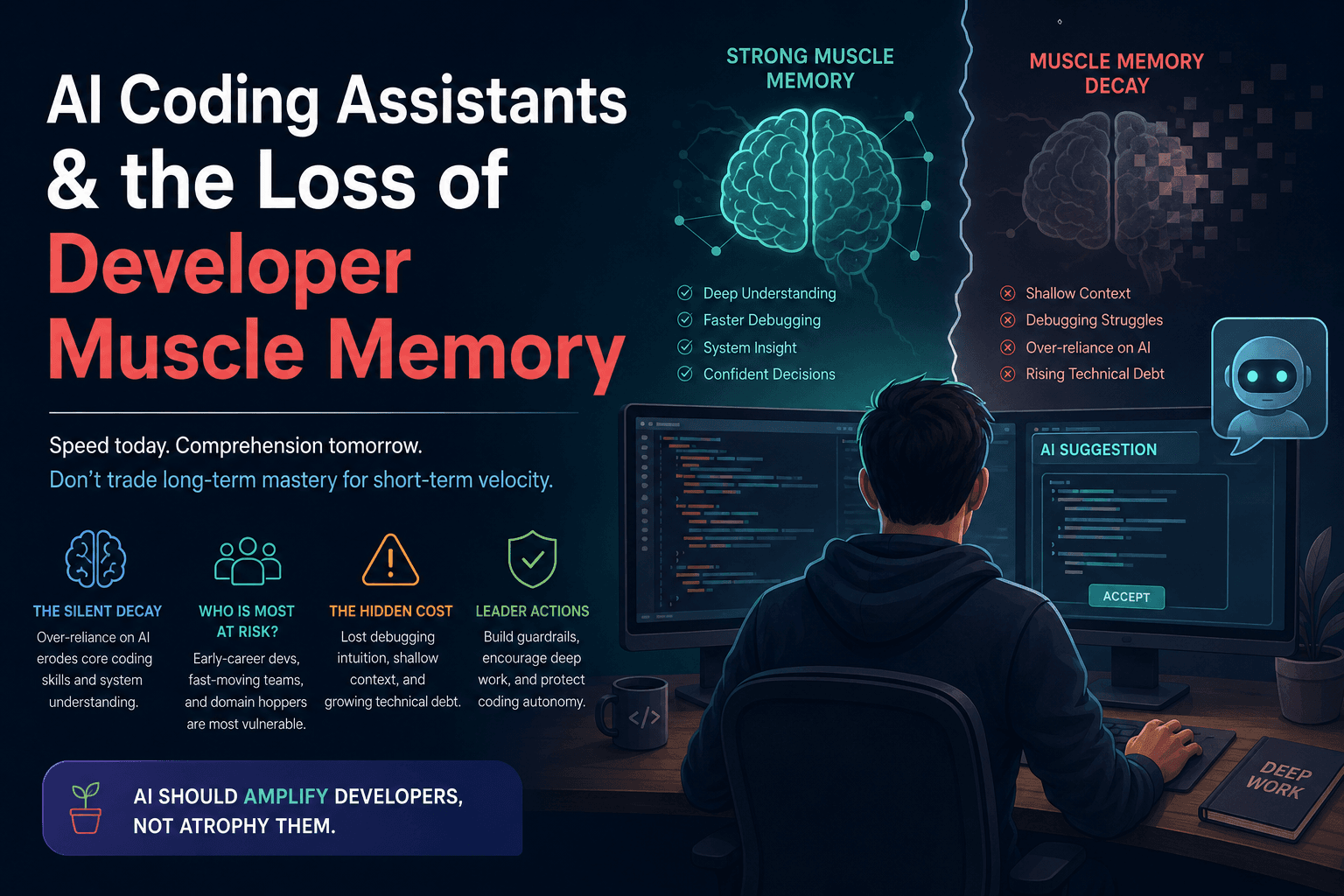
The engineering ecosystem is navigating a quiet crisis. The swift adoption of LLM-driven coding agents and auto-complete harnesses has dramatically accelerated short-term prototyping speeds. However, this productivity jump introduces a hidden cost: the erosion of engineering muscle memory. In many teams, developers are losing the practice of working through syntax and logic pathways manually, resulting in a reliance on models for even minor tasks. Understanding who is most vulnerable to this shift, what the long-term impact is for modern businesses, and how to introduce healthy boundaries is key to building resilient engineering organizations.
The Anatomy of AI-Driven Muscle Memory Decay
Software engineering relies heavily on cognitive muscle memory. Much like a surgeon or a musician, an engineer constructs a deep, intuitive mental map of systems, language syntax, and architectural patterns through manual repetition. Typing out logic, tracking state mentally, and manually debugging build errors are not secondary steps—they are primary drivers of active synthesis and information retention.
When an auto-complete engine or an autonomous agent takes over the drafting stage, the developer's cognitive load shifts from active generation to passive review. Instead of retrieving concepts from long-term memory, the developer relies on recognition to verify a model's suggestions [1].
"Over-reliance on automated code completion changes the feedback loop. By skipping active recall, engineers miss out on the mental repetition that solidifies language fundamentals and system boundaries."
This dynamic is especially visible in trivial feature generation. Tasks that historically required basic algorithmic reasoning—such as mapping collections, formatting strings, configuring standard API parameters, or writing regex—are now regularly handed off to AI prompts. The long-term result is a gradual decline in foundational knowledge, leaving developers less prepared to operate when offline, debug nested errors, or evaluate code quality without help.
Who is Most Vulnerable to This Shift?
The decline in muscle memory affects engineering organizations unevenly. Vulnerability depends heavily on an engineer's experience level and prior familiarity with manual development cycles.
| Engineering Tier | Vulnerability Level | Primary Operational Risk | Typical AI Failure Mode |
|---|---|---|---|
| Junior Developers | Very High | Inability to construct mental models, slow growth in foundational syntax, and high dependence on prompts. | Integrating complex, copy-pasted patterns without understanding code boundaries. |
| Mid-Level Engineers | High | Skipping structural validation, relying on default suggestions under deadline pressure, and loss of deep debugging skills. | Approving pull requests with hidden logical errors or unnecessary dependencies. |
| Senior Architects | Moderate | Atrophy of manual syntax execution, overconfidence in systemic reviews, and general system design degradation. | Assuming generated implementation blocks are optimized for scale and security. |
The Junior Developer "Cold Start" Crisis
Junior developers and career switchers face the highest cognitive risks. In the past, learning to program meant wrestling with build errors, reading documentation, and writing helper functions manually. This friction, though slow, helped cement mental models.
When entering an environment heavily reliant on coding agents from day one, junior engineers are often insulated from this learning curve. They bypass the initial struggle and transition straight to review roles. Because they lack a rich mental reference library, they are less equipped to spot subtle issues, optimize execution, or recognize when an AI's proposed solution is an anti-pattern.
What's in it for Companies and CEOs?
For enterprise leadership and business stakeholders, AI-driven software generation presents a complex balance sheet of short-term velocity and long-term tech debt.
The Short-Term View: Apparent Gains
For corporate leadership, coding assistants offer clear early metrics:
- Reduced Time to MVP: Teams can spin up functional prototypes, boilerplate APIs, and user interfaces at a faster rate.
- Lower Onboarding Friction: New hires can rely on natural language queries to explore codebases, reducing early guidance costs.
- Faster Routine Feature Shipping: Simple, repetitive tickets are closed quickly, improving high-level progress indicators.
The Long-Term View: Hidden Liabilities
However, focusing only on speed can mask serious operational risks:
- Single Points of Failure and Knowledge Atrophy: If key engineers leave and the remaining team relies on automated scripts to explain or run the system, deep architectural knowledge declines.
- Expanded Codebases: Generative models tend to be verbose. They often write repetitive, nested utility functions rather than clean, reusable components, leading to larger codebases that are harder to maintain.
- Complex Debugging Pipelines: When a production incident occurs, tracing a subtle issue within thousands of semi-understood, AI-generated lines of code can take much longer than resolving issues in code written entirely by hand.
A Comparative Example: AI Verbosity vs. Clean Manual Design
Let's look at how AI engines and human developers approach a common problem, such as transforming, filtering, and deeply deduplicating a nested configuration payload.
AI-Generated Approach (Verbose & Generic)
AI assistants frequently write broad, explicit logic blocks to accommodate generic use cases. This can lead to bloated helper routines:
// Generated by AI for nested key filtration & mapping
function deepProcessConfig(data) {
  if (typeof data !== 'object' || data === null) {
    return data;
  }
  let result = Array.isArray(data) ? [] : {};
  for (let key in data) {
    if (data.hasOwnProperty(key)) {
      if (key === '__meta' || key === 'tempValue') {
        continue;
      }
      let val = data[key];
      if (typeof val === 'object' && val !== null) {
        let processed = deepProcessConfig(val);
        if (Array.isArray(result)) {
          result.push(processed);
        } else {
          result[key] = processed;
        }
      } else {
        if (Array.isArray(result)) {
          result.push(val);
        } else {
          result[key] = val;
        }
      }
    }
  }
  // Remove duplicates from arrays manually written by agent
  if (Array.isArray(result)) {
    return result.filter((item, index) => {
      return result.indexOf(item) === index;
    });
  }
  return result;
}
Refined Manual Approach (Precise & Native)
In contrast, an experienced engineer using native language structures can achieve the same outcome with highly readable, performant, and maintainable code:
// Hand-written: leveraging native patterns and functional safety
const filterConfig = (obj) => {
  if (typeof obj !== 'object' || obj === null) return obj;

  if (Array.isArray(obj)) {
    return [...new Set(obj.map(filterConfig))];
  }

  return Object.entries(obj)
    .filter(([key]) => !['__meta', 'tempValue'].includes(key))
    .reduce((acc, [key, val]) => ({ ...acc, [key]: filterConfig(val) }), {});
};
How to Fix This: Strategies for Teams
The solution is not to ban automated assistants, but to build an engineering culture that values active understanding alongside tool-assisted speed.
1. Establish "Cognitive Friction" Blocks
Create designated periods—such as "No-AI Focus Hours" or "Analog Sprints"—where development is done without active autocomplete or agent code generation. This encourages developers to practice syntax recall and consult official documentation directly, keeping mental models active.
2. Run Test-First Implementation Workflows
Require developers to write unit tests manually before prompting an AI agent for code. This ensures the engineer must first design the input-output interfaces and trace the execution path themselves.
3. Introduce Explanation-First Code Reviews
Update the pull request review process to require that authors explain the underlying logic of generated blocks in their own words. This shifts the focus from simple acceptance to active comprehension.
Self-Diagnostic: Is Your Team Experiencing Cognitive Decay?
Assess your engineering dependency levels below. Choose the option that best matches your team's day-to-day workflow.
1. When writing utility functions (like sorting arrays or parsing API payloads), what is your first step?
2. How thoroughly does your team review the internal logic of generated code blocks?
3. Could your junior engineers design and explain their current architecture on a physical whiteboard?
Understanding the Path Forward
How can we structure onboarding to prevent early decay?
During the initial onboarding weeks, consider requiring developers to build simple, core tasks without code assistants. This encourages them to learn database layouts and API models manually before adopting AI toolsets.
Does this mean we should limit the use of coding assistants?
No. The goal is balance. Coding assistants are helpful for boilerplates and debugging. The objective is to keep automated helpers from replacing original engineering thought, research, and design.
Conclusion & Next Steps
As software engineering tools become more automated, the value of deep technical expertise changes. Teams that rely on automated systems without maintaining their core engineering skills may face unexpected technical debt and maintenance challenges. Organizations can build a more stable development cycle by emphasizing fundamental coding skills, prioritizing system design over raw output speed, and utilizing generative tools with deliberate boundaries.
Explore related articles and frameworks on our Engineering Strategy Blog, or learn about our upskilling pathways on the Bharat AI Career Labs Resources page.